Global buyers often view Carton Flow Storage as a simple way to improve picking speed and stock rotation. In practice, performance depends on carton weight, packaging strength, lane length, and replenishment habits. A system that works well in a dry warehouse may struggle in humid conditions or under heavy daily traffic. Small details matter.
This guide presents seven practical tips for evaluating carton flow systems across international projects. It covers product dimensions, roller selection, FIFO control, rack compatibility, safety features, installation quality, and supplier support. Each recommendation reflects common warehouse engineering principles and observations from real storage environments. Check the specifications carefully. Marketing claims rarely explain every operating limitation.
Experienced buyers should also question their own assumptions. A dense layout may save floor space but slow replenishment. Lightweight cartons may require different wheel spacing than rigid cases. Even experienced teams miss this. Request load testing, clear drawings, maintenance guidance, and reference projects before approving production. Confirm measurements in writing, especially when suppliers and warehouses operate in different countries. Local climate, handling equipment, and workforce training can change the result.
Reliable purchasing is not only about the lowest quotation. It requires evidence, realistic operating data, and communication that survives translation. The following seven tips will help global buyers compare options more carefully, reduce avoidable installation problems, and choose a carton flow solution suited to actual warehouse conditions. One caution remains: no storage design is perfect. Review it after use, then improve what the data reveals.
Segment SKUs with ABC analysis before selecting carton flow storage. A-items often represent 70–80% of annual consumption value, according to inventory-control guidance used by ASCM and APICS. This is value, not always unit demand. That distinction matters. A low-cost fast mover may need more picking space than an expensive slow mover. Review twelve months of order lines, seasonal peaks, case dimensions, and expiry dates. Do not trust one report.
Place A-items in the shortest, safest picking paths. Carton flow lanes can support FIFO rotation, clear replenishment, and rapid front access. Keep heavy cartons between waist and shoulder height when possible. The Occupational Safety and Health Administration emphasizes reducing awkward lifting and excessive reaching in material handling. A practical lane may hold two days of A-item demand, not two weeks. Measure it.
Use B-items for flexible lanes and C-items for higher or less accessible storage. The 2024 MHI Annual Industry Report found that 55% of surveyed supply-chain professionals planned to increase technology investment. Technology helps, but clean data still matters more. Test slotting with real pick-time observations. Recheck classifications monthly during promotions or market changes. ABC boundaries can be wrong. I have seen “A” lanes become congested because planners counted units, but ignored replenishment time, carton crush risk, and travel distance. Even the best model needs a physical walk-through.
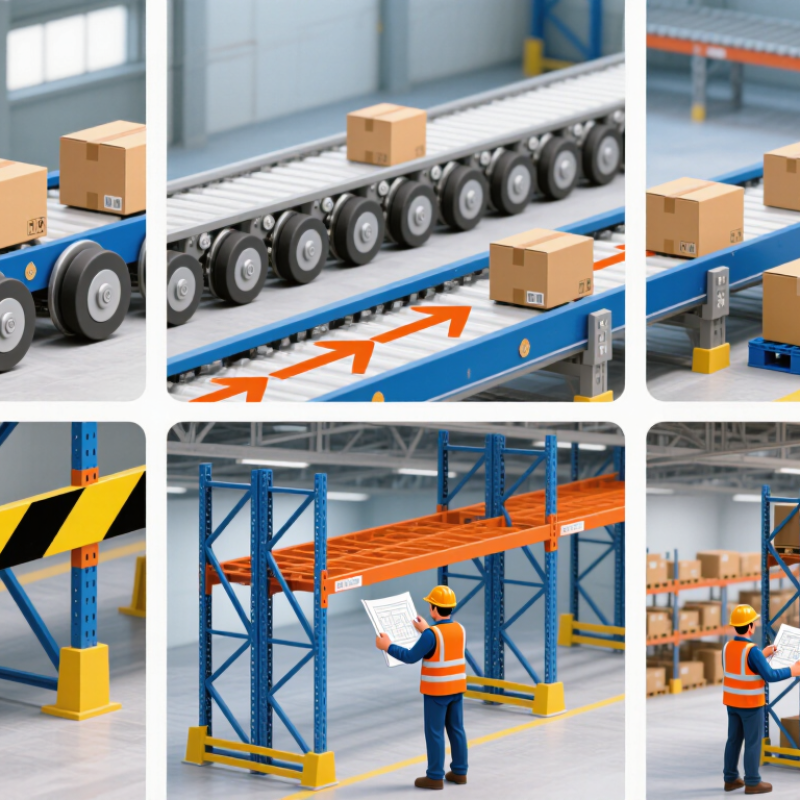
A 3–6% slope helps cartons move by gravity while preserving FIFO rotation. The correct angle depends on carton weight, base friction, and lane length. Corrugated cartons may stall when surfaces collect dust or labels catch on rollers. Test representative cartons before approving the final design.
Keep the lane width slightly wider than the largest carton. Excess clearance can create skewing, while tight clearance causes friction and damage. Use adjustable guide rails and inspect roller spacing near the loading face. A four percent slope often provides a practical starting point, but it is not a universal answer. Real cartons behave differently.
MHI’s 2024 Annual Industry Report found that 55% of surveyed supply-chain professionals planned to increase technology and innovation investment. Gravity flow remains valuable because it uses limited power and supports simple visual control. WERC’s DC Measures research also emphasizes measurable warehouse performance, including order accuracy and cycle efficiency. Record stoppages, carton damage, and replenishment time during trials. Small failures matter. One overlooked crushed corner can reveal poor rail alignment, weak packaging, or an unsuitable slope. Review the data after each test, then adjust the lane rather than assuming the drawing is correct.
7 Carton Flow Storage Tips for Global Buyers
Size Lane Width and Depth with 25–50 mm Clearance Around Cartons
Carton flow lanes perform best when dimensions reflect real cartons, not ideal drawings. Measure carton length, width, and height across several production batches. Add 25–50 mm of clearance around each carton to prevent rubbing, twisting, and loading delays. Confirm whether the supplier means total clearance or clearance on each side. This small detail can change the lane size significantly. Keep it clear.
Tip 1: Test the largest carton first. A crushed corner may need extra room. Also check the smallest carton, because excessive space can cause sliding or unstable movement. Lane depth should support the carton fully without allowing its front edge to catch on the rollers. Leave enough rear space for replenishment access and safe hand placement.
Tip 2: Trial the lane with actual cartons, labels, inner packaging, and different weights. Carton surfaces are rarely perfect. Dust, humidity, and uneven bottoms can affect flow speed. A practical trial may reveal that 25 mm works for rigid cartons, while softer cartons need closer to 50 mm. That is not wasted capacity; it may reduce product damage and picking effort. Review the result with operators before approving production drawings. Measurements can still be wrong. Recheck them.
| Tip | Carton Profile | Carton Size (L × W × H, mm) |
Clearance Per Side / End |
Recommended Lane Width |
Recommended Lane Depth |
Roller Pitch | Practical Storage Guidance |
|---|---|---|---|---|---|---|---|
| 1 | Small, rigid cartons | 300 × 200 × 150 | 25 mm | 250 mm | 350 mm | 50–75 mm | Use a lane width equal to carton width plus 50 mm. Keep the carton base flat and avoid excessive side movement. |
| 2 | Medium general-purpose cartons | 400 × 300 × 250 | 25 mm | 350 mm | 450 mm | 75–100 mm | A 50 mm total side allowance usually provides stable guidance while leaving room for normal carton variation. |
| 3 | Large or heavier cartons | 600 × 400 × 300 | 50 mm | 500 mm | 500 mm | 75–100 mm | Allow 50 mm on each side for dimensional variation. Verify that the rollers support the carton base without sagging. |
| 4 | Deep cartons for reserve picking | 500 × 350 × 250 | 25 mm | 400 mm | 550 mm | 75–100 mm | Set lane depth to carton length plus 50 mm. Do not make the lane so deep that replenishment becomes difficult. |
| 5 | Soft-sided or flexible cartons | 400 × 300 × 200 | 50 mm | 400 mm | 500 mm | 50–75 mm | Use wider clearances to prevent compression and snagging. Test the actual carton surface before finalizing roller type and pitch. |
| 6 | Mixed-SKU carton lane | 350–500 × 250–350 × 150–300 | 25–50 mm | 400 mm | 550 mm | 75–100 mm | Size the lane for the largest regular carton, but confirm that the smallest carton still tracks and presents safely at the pick face. |
| 7 | Export cartons with dimensional variation | 600 × 400 × 350 | 50 mm | 500 mm | 700 mm | 100 mm | Use the upper end of the clearance range when packaging can swell, deform, or vary between international suppliers. |
Planning rule: Recommended lane width = carton width + 2 × side clearance. Recommended lane depth = carton length + front/end clearance. Validate the final dimensions with representative cartons, maximum load, roller friction, and the required replenishment direction.
7 Carton Flow Storage Tips for Global Buyers
Verify Roller Loads, Rack Capacity, and Safety Factors Before Ordering
Tip 1: Confirm the roller load with real carton data. Measure carton weight, width, length, and base condition. A smooth box may roll well during testing but stop in daily use. Check both static and moving loads. Ask for test results using cartons similar to yours.
Tip 2: Match rack capacity to the complete installation. Include frame weight, track weight, carton impact, and uneven loading. Do not rely only on the quoted beam rating. Rack depth, bay width, and floor condition can change performance. A clear capacity label should remain visible after installation.
Tip 3: Review the safety factor with a qualified engineer and local requirements. The correct factor depends on load type, handling speed, seismic risk, and expected misuse. More is not always better; excessive restraint can reduce useful capacity. Request drawings, load tables, material details, and inspection guidance before ordering.
Small details matter.
A common mistake is testing one perfect carton. Real warehouses contain crushed corners, mixed sizes, and rushed replenishment. Leave practical clearance around cartons, and check that dividers cannot shift under impact. I would also repeat the load test after assembly, because transport or installation can loosen components. The first calculation may be correct, yet still incomplete.
Compare suppliers beyond quoted price.
An ISO 9001 certificate shows a quality management system, not perfect carton-flow performance. Request the latest audit scope, corrective-action records, and process controls for roller spacing, loading, and replenishment. Measure a live lane with cartons, gloves, and a stopwatch. I still see suppliers quote capacity without testing carton friction.
Incoterms 2020 must match the physical shipment plan.
Under DAP, the seller arranges transport to the named place, while import clearance remains the buyer’s responsibility. Under FCA, the handover point needs precise wording, such as a terminal or warehouse door. Vague locations create unexpected handling charges. The World Bank’s 2023 Logistics Performance Index reported that international shipments can take a median 44 days from export-border entry to destination. Small delays matter.
Build a total-cost sheet, not a unit-price comparison.
Include carton-flow modules, installation, packaging, inland transport, ocean or air freight, insurance, duties, taxes, customs brokerage, storage, damage, and replenishment labor. UNCTAD’s Review of Maritime Transport 2023 states that shipping carries over 80% of global merchandise trade by volume, so freight exposure deserves careful testing. Compare landed cost per usable carton position. Then test access time and pick accuracy. The cheapest lane may waste labor. An imperfect forecast is still better than no sensitivity analysis. Recheck costs at three demand levels.
A 3–6% slope often supports gravity flow and FIFO rotation. A four percent starting point is practical. Test real cartons before approval.
Dust, rough carton bases, caught labels, and damaged corners can interrupt movement. A clean test box may perform differently. That difference matters.
Make the lane slightly wider than the largest carton. Too much space causes skewing. Too little space creates friction and damage.
Provide carton weight, width, length, base condition, and expected loading pattern. Include mixed sizes and imperfect cartons. One perfect carton is not enough.
Test static and moving loads using cartons similar to daily inventory. Inspect roller spacing near the loading face. Ask for recorded test results.
Include frames, tracks, cartons, impacts, uneven loading, and floor conditions. Do not rely only on beam ratings. Keep capacity labels visible.
Request drawings, load tables, material details, inspection guidance, and safety-factor information. A qualified engineer should review local requirements. More restraint is not always better.
Compare quality controls, shipment terms, installation, freight, taxes, duties, damage, and labor. A quality certificate does not prove perfect carton-flow performance. Test a live lane.
Include equipment, installation, packaging, inland transport, freight, insurance, customs, storage, and replenishment labor. Then compare access time and pick accuracy. The cheapest option may waste labor.
Carton Flow Storage can improve picking speed, stock rotation, and warehouse organization when it is planned around real demand. Start by grouping SKUs with ABC analysis: A-items commonly represent about 70–80% of total demand, so they should receive the most accessible and efficient lanes. For reliable FIFO movement, design lanes with a controlled 3–6% slope, allowing cartons to move smoothly from replenishment to picking positions without excessive speed. Lane width and depth should also match carton dimensions, with approximately 25–50 mm of clearance to prevent friction, jams, and difficult handling.
Before placing an order, verify roller load ratings, rack capacity, and suitable safety factors for both daily use and peak inventory levels. Global buyers should evaluate suppliers through more than purchase price, reviewing ISO 9001 quality practices, Incoterms 2020 responsibilities, lead times, installation support, and total cost of ownership. A careful comparison helps ensure that the selected system delivers dependable performance, safe operation, and long-term value across different warehouse environments.

JGY Shelf